Knowledge
Deep Dive
What parts does an RFID system consist of? Detailed explanation of each component function
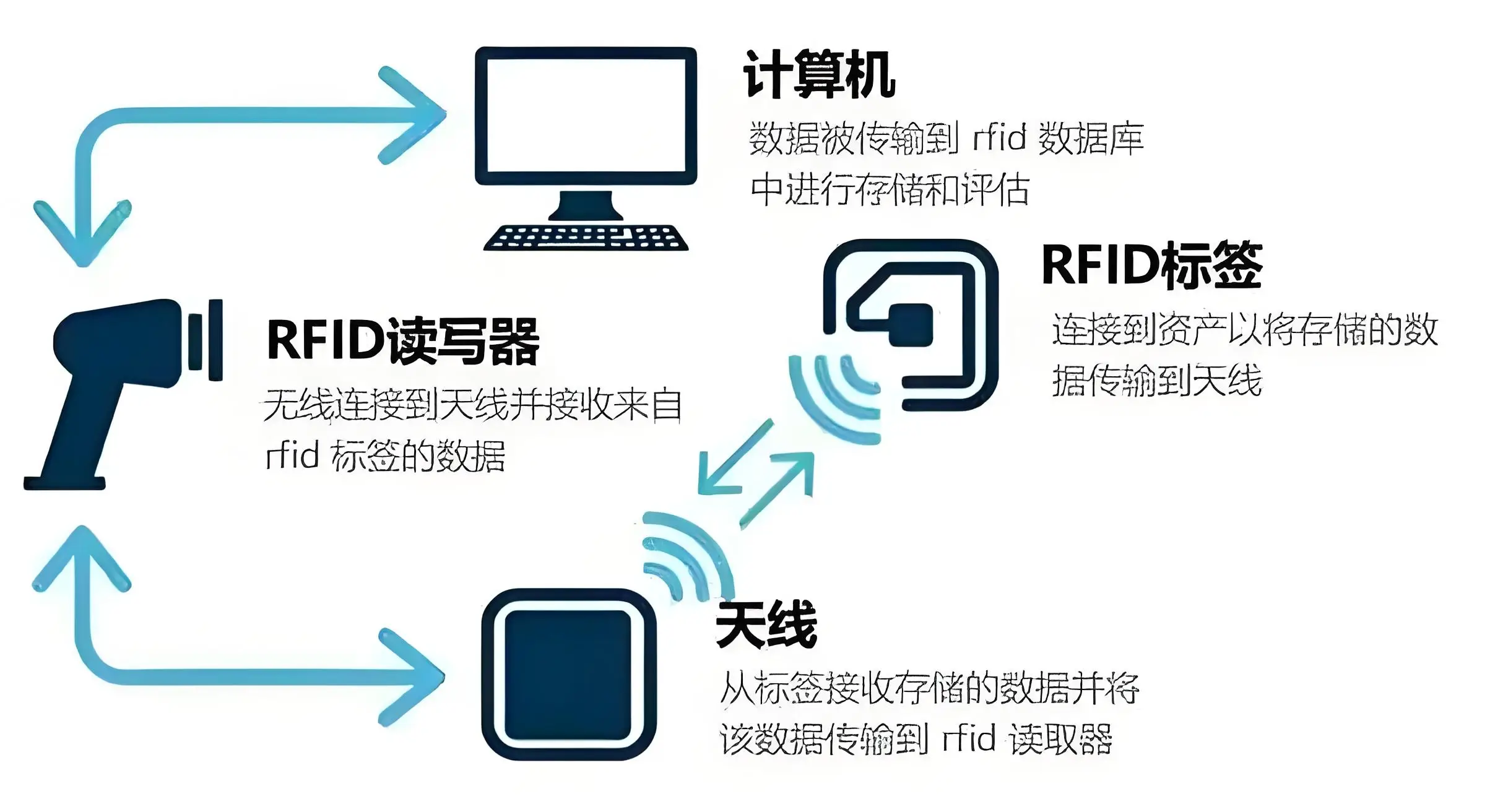
A complete RFID system mainly consists of three parts: electronic tag (Tag), reader (Reader), and antenna (Antenna). In addition, a dedicated application system is needed to process the reader's identification.
(1) Electronic tag (Tag): Also known as radio frequency tag or transponder, it consists of a chip and an internal antenna. The chip stores electronic data in a specific format, serving as the identification information of the item to be identified and the data carrier of the RFID system. The internal antenna is used for communication with the RF antenna. Each tag has a unique electronic code and is attached to the object to identify the target.-
(2) Reader: Also called reading device, scanner, read head, communicator, or reader/writer (depending on whether the electronic tag can be wirelessly rewritten), it is a device that reads (and sometimes writes) tag information. It can be designed as a handheld RFID reader or a fixed reader. Its main task is to control the RF module to emit a read signal to the tag, receive the tag's response, decode the tag's object identification information, and transmit the object identification information along with other relevant information on the tag to the host for processing.
(3) Antenna: The antenna is a device that transmits RF signals between the tag and the reader. The communication between the application and the reader is wired (can be serial port or USB port), and the communication between the reader and the electronic tag is wireless. The basic communication flow is: application → reader → electronic tag → reader → application.
(4) Backend system: The backend system consists of a PC, database, or cloud platform. It is responsible for processing data collected by the reader and controlling the working status of the reader. It is the 'brain' of the entire RFID system. Antenna size and polarization mode directly affect reading distance and stability, and the performance of the antenna plays a very critical role in the overall system performance—antenna size, directivity, antenna position, electrical characteristics of the operating frequency band, and surrounding environment all affect the read/write distance.